

Meet the PCAPS SG: Gunilla Svensson on understanding processes in polar models
This month’s Meet the SG blog post features PCAPS SG member, Gunilla Svensson, who is a Professor of Meteorology at Stockholm University, Sweden and is the co-lead of the PCAPS Processes Task Team.
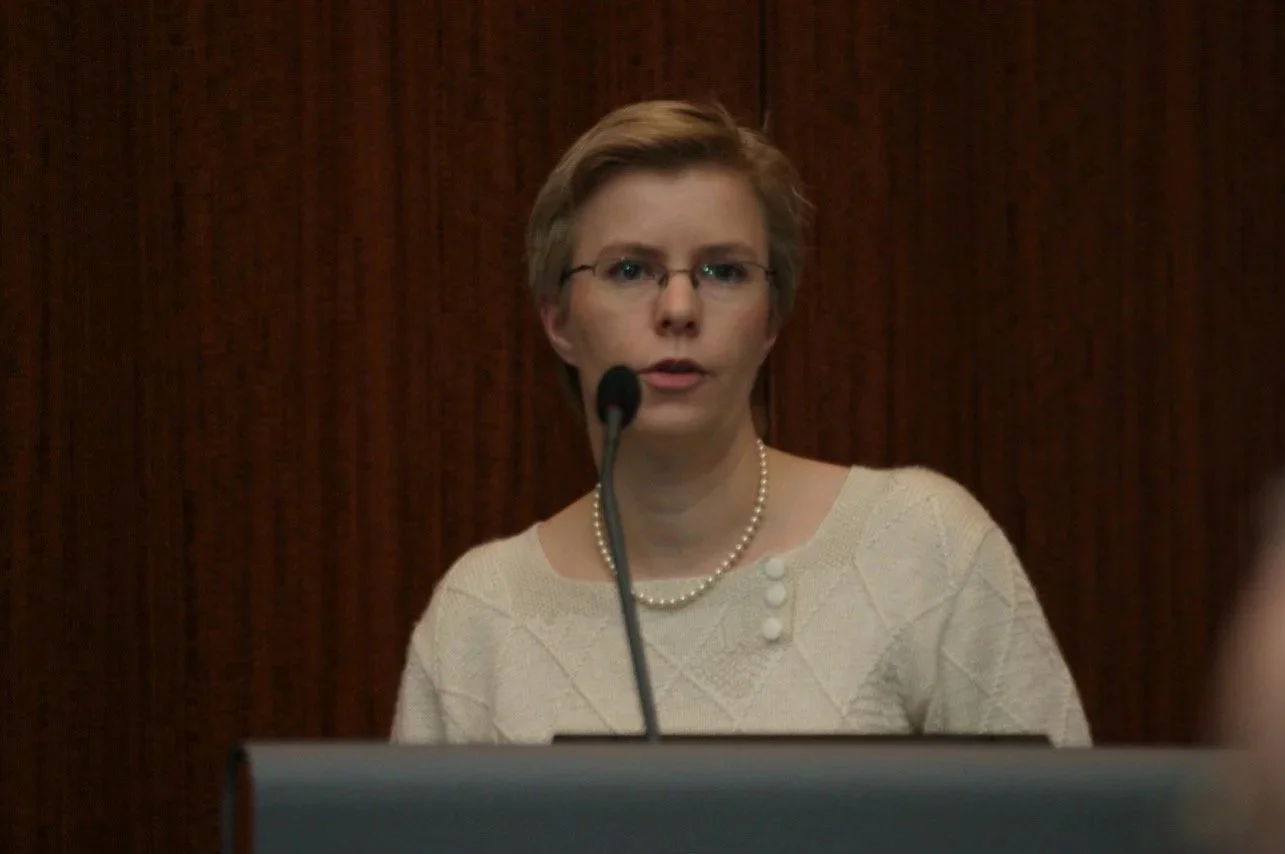
Gunilla presenting in Reykjavik, Iceland, during the ACIA International Scientific Symposium on Climate Change in the Arctic, 2004. She is a contributing author to the ACIA report. Photo courtesy of Gunilla Svensson.
I am a numerical modeler and I am interested in particular in how small-scale processes such as turbulence and clouds are represented in global models used for numerical weather prediction and climate projections. To further this understanding, I develop and use numerical models for a range of scales, such as direct numerical simulations of turbulence that interacts with individual cloud droplets, large eddy simulations of the turbulent atmospheric boundary layer, and a coupled atmosphere ocean single column model that describes a column from the bottom of the ocean to the top of the atmosphere. The tools are used in combination with observations to understand the processes with the aim to improve their representation in global models used for weather and climate. While I am interested in this for all locations on the globe, I have a particular interest for the polar regions which is one reason for my role as a PCAPS Task Team (TT) lead. I also believe that it is important and more fun to work together on difficult problems, which is what we can do in the Process TT.
I am writing this on the commuter train between Uppsala, where I live, and Stockholm where I work. The landscape outside is magically white with a deep blue gray sky and some hints that there will maybe be a bleak winter sun later today, which will make everything sparkle. Sweden was hit by a snow storm ten days ago and SMHI was very busy providing warnings of all colors - yellow, orange and red - for several days in a row. Infrastructure was hit hard. Across the country, there have been delayed or cancelled trains and power outages for up to two weeks, as many trees fell over the lines and broke them. The recent episode highlights the importance of having good forecasts that other agencies can trust and know how to use the warnings.
I grew up following the weather closely as my parents came from a farming environment, even though the family business had changed to a taxi company. If you look at maps of climatologies over southern Sweden, I come from the region with the precipitation maximum. Weather was discussed a lot and everyone had to be quiet during the radio or tv weather reports. When it was time for me to choose university studies, I chose the physics program in Uppsala as it had meteorology, a choice I have never regretted.
Already as an undergraduate, I had the opportunity to attend a research school that was held in the Swedish mountains in Abisko. As part of the course, we did some field work and I have a fantastic memory of skiing to empty the data logger in the middle of the night. The skies were full of Nordic lights and when we arrived at the mast, the temperature was well below -30 C and the surface inversion was massive. That was my first time north of the Arctic Circle.
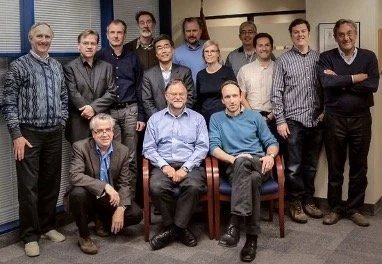
WWRP Polar Prediction Project (PPP) Steering Group Meeting in Montreal, 2014.
Photo courtesy of Gunilla Svensson.
During my career, I have worked on a range of different topics not related to the Arctic at all but when I got my first funded research project to hire my first PhD student, it concerned stably stratified boundary layers. That work led me on the route of coordinating international research activities. As such, I became a co-lead of the GEWEX Atmospheric Boundary Layer Study (GABLS), which in turn some years later lead to an invitation to be part of the Steering Group of the WMO-WWRP Polar Prediction Project. Since then, I have completed a number of research studies and supervised many PhD and master students on the representation of small-scale processes in numerical weather prediction and climate models in polar regions, along with conducting studies on what contributes to the Arctic amplification. In those studies, I have always used substantial amounts of observations but more recently, I have become much more involved in how to acquire observations in remote regions as I have taken on the role as coordinator for the infrastructure that takes atmospheric observations on the Swedish icebreaker Oden.
In PCAPS, I continue to discuss and coordinate activities regarding the representation of processes, the most recent plans are presented here.