

PCAPS Processes Task Team recent workshop highlights
The PCAPS Processes Representation Task Team (TT) hosted a workshop in Stockholm 1-2 December 2025. The local organizer was Gunilla Svensson, with financial support from the International Meteorological Institute (IMI) at Stockholm University and excellent practical arrangements by Henriette Valsö. The focused workshop covered four specific topics that were discussed and defined in the TT’s online meetings leading up to the workshop. This was quite useful in guiding the selection of invited guests to support the TT members in the discussions. The workshop was attended by almost all the TT members and a handful of invited experts. In total, nine people attended in-person, which was reinforced by very active participation from twelve online participants.
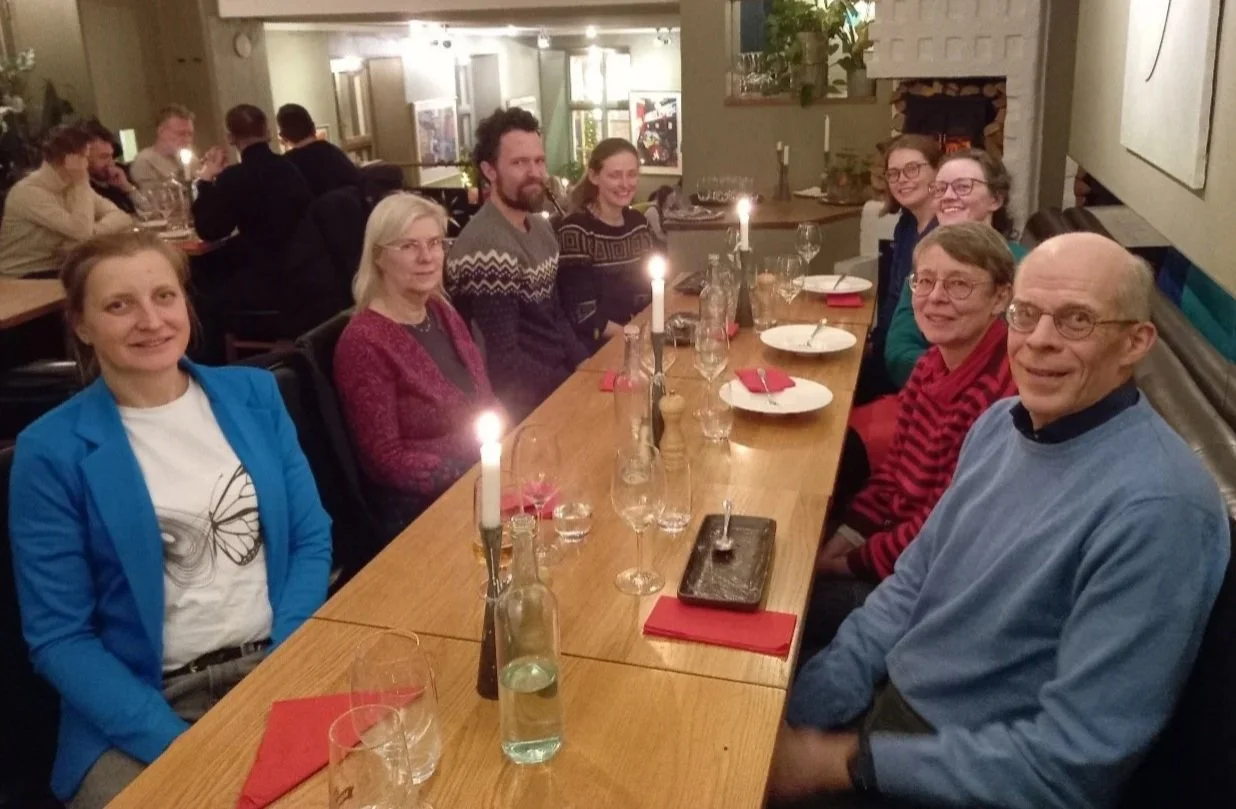
The workshop participants in Stockholm enjoyed a nice dinner in Old Town, also sponsored by IMI. Photo credits: Linus Magnusson
The workshop was organized around the following four topics:
Review paper outlining the progress in understanding the processes that needs to be well-represented to get a good coupling between atmosphere-sea ice-ocean or atmosphere-land, and what is needed to improve them
Discuss how we can advance the merged data format with concrete activities
Outline a project that uses the value cycle as a foundation together with the PCAPS Service & Actionability and Sustainability & Impact TTs
Discuss and define targets for the three-year term of the Processes TT
Most of the first day was devoted to targeted presentations on ongoing projects and ideas for the two first topics. These covered a broad range of scales and topics and both poles. The discussion that followed the presentations was very inspiring and lead to a range of new connections, thoughts and ideas of activities. All this was reported back during the last session on the second day that concentrated on the fourth topic. At the end of the workshop, we arrived at a list of challenges that remain and are hampering the progress in understanding the processes that needs to be well represented to achieve a realistic coupling between the atmosphere and the surface in the polar regions. The goal with this activity is to write a paper on this with the aim to guide model evaluation and improvements by listing what we expect the models to handle while at the same time provide suitable process-oriented and/or regime-based diagnostics for assessment.
The availability of observations to assess representation of processes were discussed in the light of the data format developed during PPP and used in the YOPPsiteMIP project. A thought-provoking statement suggested that maybe it is not “lack of data” that is the problem, but rather, a “lack of time (resources)” for the evaluation of processes. This reformulation makes it even more clear that it is not enough that data is available and published using the FAIR principles. The TT concluded that they will continue to promote the merged data format for observations and models (MODF and MMDF, respectively) through the practical use in the projects that we are involved in. It was further emphasized that we should promote their use for new field campaigns (aircraft and icebreaker expeditions were mentioned) and observatories. The TT welcomes the interest of the ACCORD consortium to collaborate on process-oriented diagnostics based on MODFs and MMDFs.
The session after lunch the second day started with an inspiring introduction by aviation forecaster Nicke Juuso describing his work as the ship forecaster onboard the Swedish icebreaker Oden, on loan from the Swedish Armed Forces where he normally works. He described what he used to make and communicate a visibility forecast to the Ship Captain and the helicopter pilot during last summer’s expedition to the Arctic. This was followed by a presentation and workshop about using the forecasting value cycle arranged by Jelmer Jeuring and Machiel Lamers from the Service & Actionability and Sustainability & Impact TTs, respectively. This also revolved around the visibility forecast variable and resulted in a very nice discussion on the forecast product and what processes that are important and how it can be evaluated and improved. It was clear from the forecaster presentation that the model-based visibility forecast variable is not usable in the high Arctic presently. As a result of this activity, the early career TT member Luise Schulte from ECMWF & the University of Cologne, will coordinate a small project on this. She attended the WWRP-PCAPS-endorsed Canada-Sweden Arctic Ocean 2025 research expedition research school on last summer expedition. She and her fellow atmospheric students will further investigate this based on their experiences last summer and possibly provide some forecast products for the next summer forecaster and ERCs that will be part of the expedition in summer 2026.
In sum, the recent Processes TT workshop outlined many notable activities for the forthcoming months and years. Stay tuned for more updates as things develop.