

Meet the PCAPS SG: Andrew Orr on understanding climate processes and change in Antarctica
This month’s Meet the SG blog post features PCAPS SG member, Andrew Orr. Andrew is a Climate Scientist at the British Antarctic Survey and in addition to being a PCAPS SG member, is the co-lead of the PCAPS Processes Task Team. He researches the processes responsible for climate change and variability in the polar regions, and recently, has been investigating extreme weather events in the Antarctic and Himalayan region, which despite their high impact, are poorly understood.
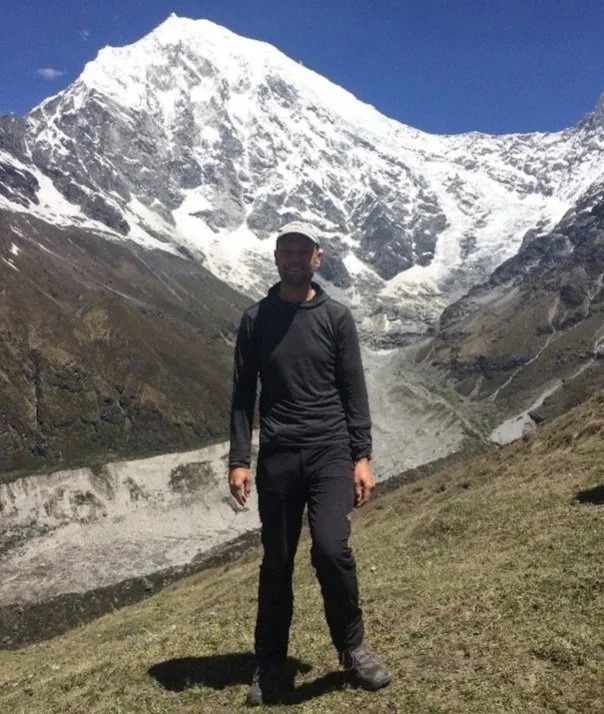
Andrew in Langtang Valley, Nepal, 2019. Photo courtesy of Andrew Orr.
My undergraduate degree was in physics. My PhD was in radio physics, so completely unrelated to polar climate research. However, following my PhD I took up a postgraduate research position at University College London (UCL) in 2001 on atmosphere/ocean/sea-ice processes in the polar regions. This was working with Julian Hunt, Professor in Climate Modelling at UCL, who is one of the most inspiring and extraordinary people I have ever met, with a wide-range of interests, including fluid mechanics and turbulence, but also policy. I worked here for 4 years, which set me on my career focused on investigating the processes responsible for climate variability and change in the polar regions. At this time, my main research interest was on the effects of orography on atmospheric flow, such as low-level blocking and foehn winds. This was predominately using regional climate models, although I also performed experiments using the large rotating tank of the Coriolis-LEGI laboratory in Grenoble, France.
After this, I worked at ECMWF for 4 years on improving the representation of sub-grid orography in their forecast model, as well as sub-grid non-orographic gravity waves. I then joined the British Antarctic Survey (BAS), where I now work as a climate physicist. After joining BAS, my interests focused again on Antarctica and the role of orography and regional climate modelling (particularly through the Polar CORDEX (Coordinated Regional Downscaling Experiment) project). However, I also began to take an interest in the hydroclimate and meteorology of mountain regions, especially the Himalayas. I was motivated by the huge populations that depend on water resources from snow and glacier melt and summer monsoonal rainfall from these regions. Although I have never been to either the Antarctic or the Arctic, I have been to the Himalayas. Other interests that I have since developed are troposphere-coupling of the Antarctic ozone hole and the generation of polar stratospheric clouds by mountain waves.
Contributions to PCAPS
As a climate modeller focused on Antarctica, I am very aware of the need to provide more accurate predictions of critical polar processes, particularly related to small-scale processes essential for accurate forecasting. These are PCAPS central objectives and something that I contribute to, particularly by linking it to my interests in Polar CORDEX, which now involves machine learning-based downscaling activities.
A key constraint to furthering this work remains limitations in observation networks in the polar regions, which are necessary to better assess and develop models, enhance atmospheric predictability, and better understand the effects of global climate change. PCAPS seeks to encourage the need for extensive targeted observational campaigns. For example, the recent Year of Polar Prediction in the Southern Hemisphere (YOPP-SH) and MOSAiC expedition in the Arctic have both been huge successes, with the resulting process-based observations facilitating improvements in models. There is also the planned Antarctica InSync project, which is a global effort to synchronise research across Antarctica and the Southern Ocean, connecting ice, ocean, climate, and life to protect this vital region.
I value the knowledge I have gained through my involvement with PCAPS thus far, especially around environmental well-being, socioecological systems, and forecasting services in the polar regions. For example, I really enjoyed co-organising the second Open Session of the Annual PCAPS Steering Group Meeting that was held at BAS in April 2025, gathering a diverse mix of about 50 Arctic and Antarctic stakeholders to share perspectives on environmental forecasting services, operational needs, and opportunities for collaboration. I am looking forward to more interdisciplinary engagement and knowledge exchange, working towards the PCAPS aim to provide more accurate, reliable, and usable prediction services.