

Season's Greetings from PCAPS
As 2025 draws to a close, we wish to take this opportunity to reflect on a year of good progress and growing international collaboration. Over the course of this year, PCAPS has brought together researchers, forecasters, operators and other stakeholders from around the world to advance environmental forecasting capabilities in both polar regions. We extend our warmest Season's Greetings to the entire PCAPS community.
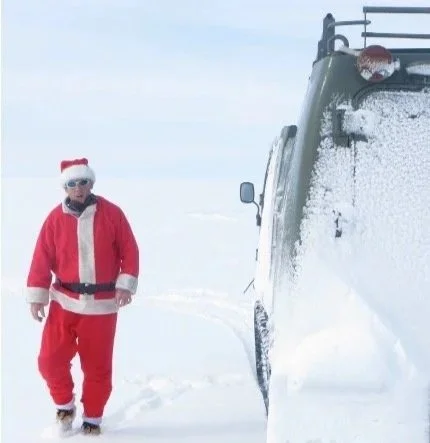
Season’s greetings from Antarctica.
Photo courtesy of Daniela Liggett.
2025 has been a year of growth and maturing for PCAPS, marked by refining our implementation plan, establishing Task Teams and making progress towards our overarching objectives. Our second annual Steering Group meeting, held at the British Antarctic Survey in Cambridge in April, provided an opportunity to review strategic and tactical milestones.
The accompanying PCAPS Open Session brought together Arctic and Antarctic researchers, forecasters and stakeholders, and highlighted that while technical challenges such as data gaps and model uncertainty remain important, the most significant barriers lie in human and institutional factors—particularly communication, coordination and shared understanding across disciplines and organisations. Addressing these challenges requires both new tools and more integrated ways of working. The bottlenecks and opportunities identified during the Open Session are already informing PCAPS research activities and contributing to early planning towards the 5th International Polar Year (IPY-5, 2032–33).
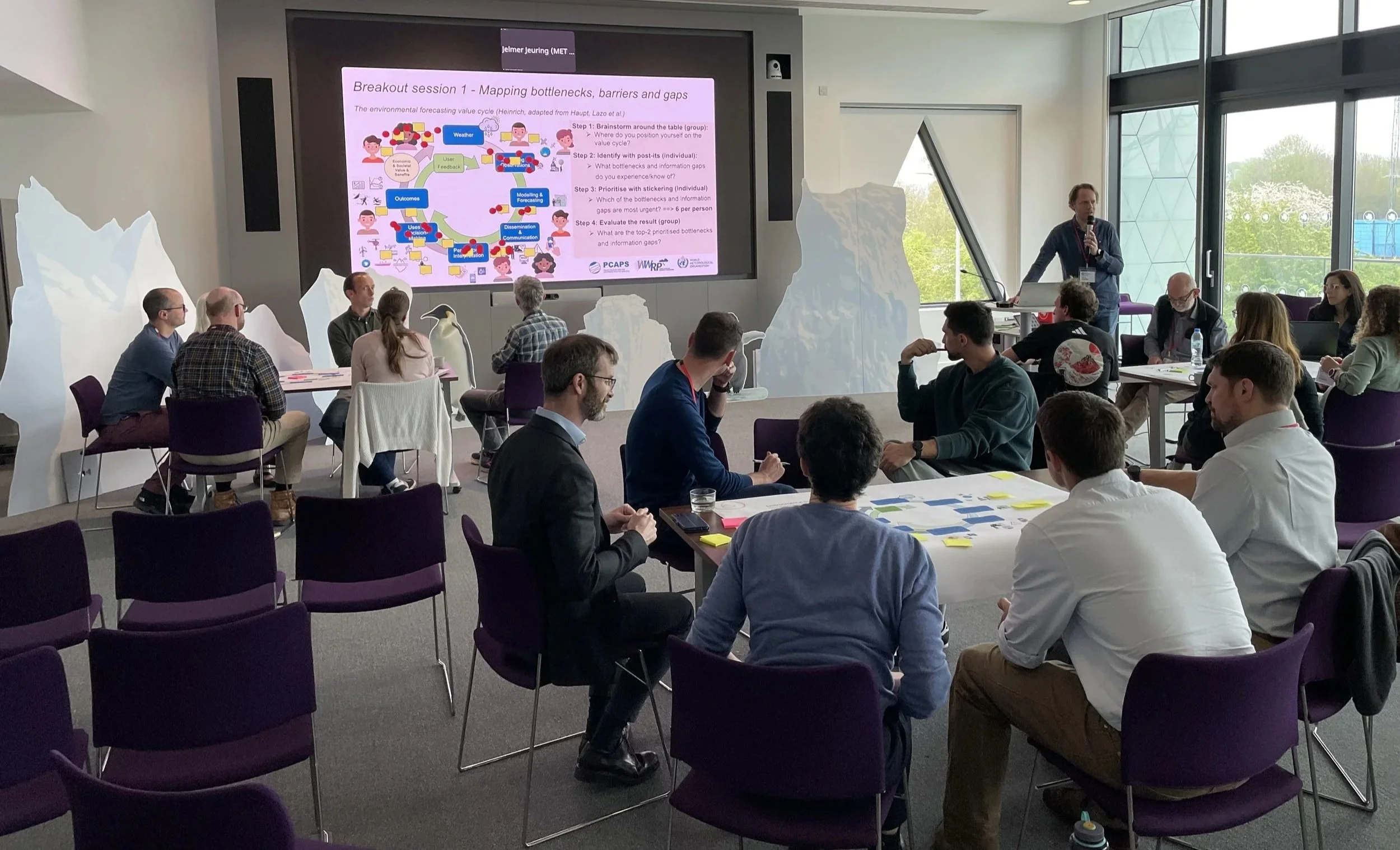
The PCAPS community continues to grow, bringing together experts from diverse disciplines and regions. Photo courtesy of Gita Ljubicic.
Throughout 2025, PCAPS Steering Group members played an active role in representing the project across a wide range of international scientific, operational and interdisciplinary arenas, as reflected in this year’s range of blog posts. Steering Group members contributed to major meetings and workshops addressing coupled atmosphere–ice–ocean processes, polar predictability and service-oriented challenges, including the Workshop on Coupled Modelling and Observations in the Arctic Marginal Ice Zone, the Getz Initiative workshop hosted by the Korea Polar Research Institute, and the inaugural Ross Sea Research Coordination Network workshop. PCAPS representation was also visible at international conferences and community events such as EGU, Arctic Frontiers, the Svalbard Science Conference, and targeted education and training activities.
Field research activities continued to play a central role in advancing understanding of polar environments and strengthening the observational foundations for prediction. There were multiple field-based efforts across both polar regions, including expeditions in sea-ice-covered waters, atmospheric and oceanic measurement campaigns, and safety and preparedness training in extreme conditions. The release of the open-access dataset from the Svalbard Marginal Ice Zone campaign (April–May 2024) provided a valuable new observational resource for studying coupled atmosphere–ice–ocean processes and for supporting model evaluation and development. The Turbulence and Supercool Clouds in Antarctica (T-SCAN) project commenced operations in January 2025, studying supercooled clouds and turbulence across the Antarctic Peninsula.
The Meet the PCAPS Steering Group blog series throughout 2025 highlighted the wide range of expertise within PCAPS and the interdisciplinary foundations of the project. Together, these contributions underscore PCAPS’s commitment to integrating physical science, observations, operations, and social science to advance actionable polar prediction.
PCAPS' commitment to inclusivity and early-career development has remained a priority. Each of the Task Teams has at least one early-career professional (ECP) involved. Our Communications Fellows, also ECPs, have undertaken valuable work investigating how polar research is taught in Norwegian schools and represented PCAPS at the University of Oslo's Geosciences Career Day. We have also worked to elevate important discussions about creating inclusive environments for early career researchers and minorities in polar science.
Looking ahead to 2026, we anticipate continued growth across all PCAPS objectives. The need for efficient data sharing, enhanced coordination, and improved predictive capabilities in the Arctic and Antarctic has never been more apparent. PCAPS is well-positioned to facilitate these efforts, ensuring that both research and operational needs are met effectively.
We extend our deepest gratitude to all members of the PCAPS community, all our Steering Group and Task Team members, endorsed project leaders and the broader network of collaborators. Special thanks go to the World Meteorological Organization's World Weather Research Programme and the PCAPS International Coordination Office for their ongoing support.
To our colleagues working in polar regions during the festive season, we send our warmest wishes for your safety and wellbeing. Your dedication to advancing polar science, often in challenging conditions and far from family and friends, is deeply appreciated.
Season's Greetings and best wishes for the New Year from PCAPS.
— Daniela Liggett and Jørn Kristiansen, PCAPS Co-Chairs