

CARRA2 offers better insights into Arctic extremes
Last week was the much-anticipated release of the second-generation Copernicus Arctic Regional Reanalysis (CARRA2) dataset by the Copernicus Climate Change Service (C3S). CARRA2 serves as a pan-Arctic regional reanalysis dataset marking a 40-year data series from 1986 to 2025. Notably, CARRA2 covers the entire Arctic region north of 65 degrees North, offering a novel opportunity to monitor extreme weather and climate variability in the Arctic region, helping to support PCAPS mission of improved environmental forecasting in the polar regions.
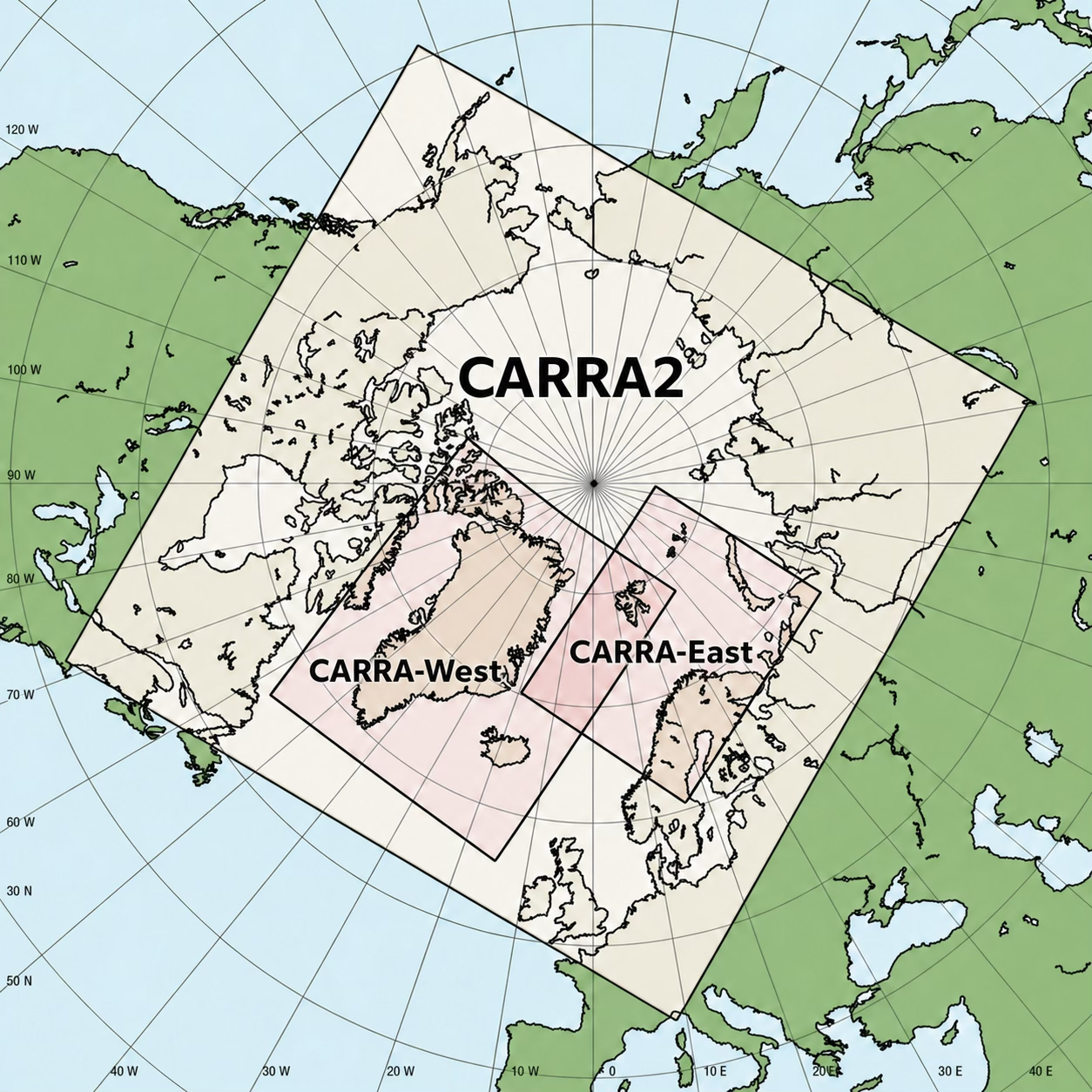
The pan-Arctic CARRA2 domain and the CARRA1 (CARRA-West and CARRA-East) domains. Source: CARRA. Photo credit: C3S/ ECMWF
CARRA2, like its predecessor CARRA1, builds on the operational Arctic numerical weather prediction models used in Denmark/Iceland/Greenland and in Norway (the “HARMONIE-AROME” system), running at a 2.5 km horizontal resolution, where many updates and extensions are added for reanalysis. CARRA1 and CARRA2 also uses historical surface observations, not used in previous reanalyses, stored in archives in the Nordic countries and Greenland. Dedicated satellite based data sets were prepared to get good high-resolution information on ocean temperatures and Arctic “cold surfaces” such as sea ice cover, snow cover and glacier albedo.
The CARRA2 release offers substantial improvements from CARRA1, which has been available and timely updated since 2021. Namely, CARRA2:
Enhances pan-Arctic coverage, spatially but also temporarily, with hourly climate data.
Offers a continuous 40-year dataset, with practical features including but not limited to geographic sub-setting and daily and monthly means, extremes, and totals in separate C3S Climate Data Store entries (see here and here).
CARRA2 builds on the global reanalysis ERA5, which forces it on the side boundaries, but provides better insights into Arctic extremes than ERA5, particularly local extremes, via finer spatial detail and resolution.
To learn more about CARRA2, read the full news release here.
In addition, for those interested to become more engaged in the CARRA2 details, hands-on usage and its user community, a CARRA2 User Workshop will be held in Copenhagen/online, 10 - 11 June, 2026.
Registration is open until 6 June.
Acknowledgements
The CARRA dataset is produced by a consortium contracted by C3S and led by the Norwegian Meteorological Institute. Partners are the meteorological services of Denmark, Sweden, Iceland, Finland and France, and the Geological Survey of Denmark and Greenland.
C3S is implemented by the European Centre for Medium-Range Weather Forecasts (ECMWF) on behalf of the European Commission.