

WAMC 2026: Antarctic Meteorology and Climate Converges in Charleston
Every year, a community of researchers, forecasters, and field operators from across the globe converges to do something that sounds deceivingly simple: get everyone on the same page about Antarctic weather. They gather at the Workshop on Antarctic Meteorology and Climate, and this year, the 21st WAMC will be held June 16–18, 2026 in Charleston, South Carolina. This year's meeting is shaping up to be a memorable one.
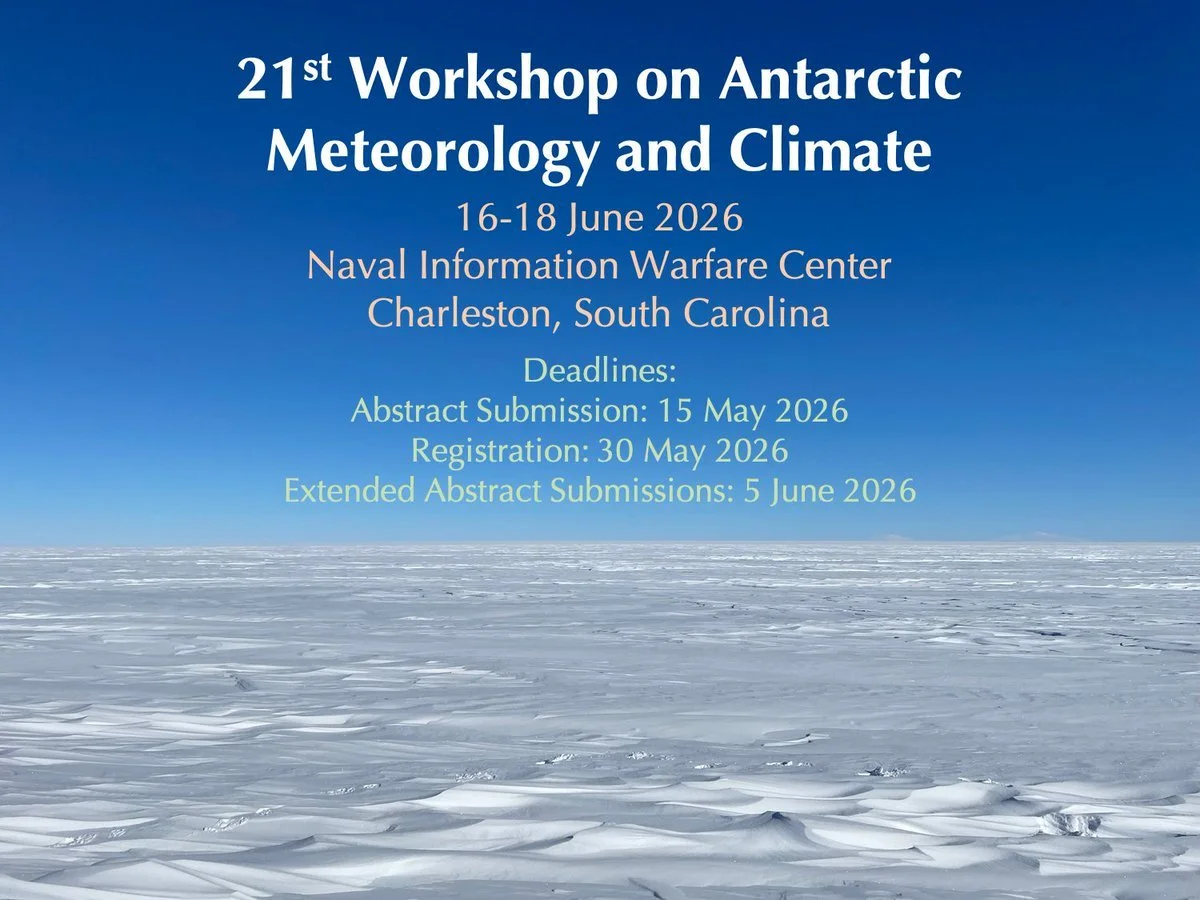
Save the Date for the 21st WAMC. Source: Antarctic Meteorological Research and Data Center
A Workshop with Deep Roots
The WAMC has long served as the premier annual forum for those working with Antarctic meteorology, climate science, and polar operations. Here, observational data meets numerical modeling, field teams debrief on seasons past, and international collaborators find a shared table.
This year’s workshop is being organized by the Naval Information Warfare Center (NIWC), headquartered in Charleston. The Navy’s connection to Antarctic science is storied: for much of the continent’s modern research history, sea transport made the Navy the natural backbone of U.S. Antarctic logistics. Even after the Department of Defense transferred primary responsibility for Antarctic aerial operations to the Air Force in 1999, the Navy retained key roles in Antarctic support—including air traffic control, ground electronics, and weather forecasting. That legacy makes Charleston a fitting host city for a meeting that has always bridged the operational and scientific.
The Antarctic Meteorological Research and Data Center (AMRDC) has been a consistent presence throughout the WAMC’s history, organizing, hosting, and contributing across many iterations of the workshop, including last year’s meeting in South Korea. AMRDC principal investigator Matthew Lazzara serves on the WAMC Planning Committee, which draws members from institutions around the world.
Three Days, One Arc
The WAMC follows a deliberate structure across its three days. It opens with reports from the field: updates from the season, firsthand accounts of what worked, what didn’t, and what the ice had to say. From there, it moves into the technical core: instrumentation, observational networks, and the numerical modeling systems that underpin both research and real-time operations. The final sessions scale back to broader scientific questions, grounding the week’s discussions in the bigger picture.
It’s a format that rewards showing up. As AMRDC researcher Taylor Ziegler puts it, there’s something irreplaceable about the in-person energy of a meeting like this: the chance to reconnect with colleagues, hear firsthand updates from fieldwork, and have the kinds of hallway conversations that don’t happen over email.
For those who can’t make it to Charleston, the workshop is fully hybrid, with virtual participation available throughout.
The New Addition: A Deep Dive into AWS Technology
The headline development for this year’s WAMC is a devoted segment of the meeting on automatic weather station (AWS) technology, a first for the workshop.
Antarctica’s AWS network is one of the most logistically demanding observational systems on Earth. Stations are scattered across the continent and its surrounding islands, maintained by teams from multiple nations, operating under conditions that push instrumentation to its limits. The challenge goes beyond just keeping the stations running. It’s a coordinated effort across a patchwork of systems, organizations, and data pipelines that have evolved largely in parallel.
The new AWS working group is designed to bring those threads together. The session will take a close look at the challenges facing automated systems currently deployed across Antarctica, with a particular focus on practical questions: How can groups working on similar problems support each other more efficiently? Where does system commonality make sense? How do we improve data transport and availability for the broader community?
“The goal is fostering collaborative discussions,” says Lazzara. “How can the different groups working on Antarctic weather stations be more efficient? How can they support each other and function as a more collaborative, cooperative team?” For a scientific community that depends on high-quality, continuous observational data from one of the most remote places on Earth, those are exactly the right questions to be asking.
Why This Matters for PCAPS
The WAMC’s relevance extends well beyond Antarctic specialists. Polar prediction is central to the PCAPS mission, and it’s an area where year-over-year progress has been tangible. Each workshop surfaces improvements in technology that push the quality of Antarctic forecasts forward. For a community focused on deriving actionable services from polar environmental science, the WAMC is one of the best annual checkpoints on where the field actually stands.
Mark Your Calendars!
Dates: June 16–18, 2026
Location: Hilton Garden Inn Waterfront/Downtown, Lockwood Drive, Charleston, SC (hybrid)
Short abstracts due: May 15, 2026
Registration deadline: May 30, 2026
Extended abstracts due: June 5, 2026
One more important note: there are no registration or abstract fees this year. For graduate students, early-career researchers, and anyone working within tighter travel budgets, that’s a meaningful invitation to participate.
For more information, including registration details, please visit the AMRDC website.