

Into the Arctic night: Scientists gear up for a groundbreaking mission in Inuvik
PONEX is a surface and aircraft campaign designed to explore atmospheric physics and chemistry in the Canadian Arctic in polar night and polar sunrise conditions. This is the first experiment of its kind.
In January 2026, as the Arctic plunges into its long, sunless winter, 44 scientists and graduate students from around the world will head north for the Polar Night Experiment (PONEX), a first-of-its-kind research campaign led by Environment and Climate Change Canada (ECCC) and the National Research Council of Canada (NRC), with support from the Canadian Space Agency (CSA) and international partners like NASA, European Space Agency (ESA), over a dozen universities, and approximately 50 scientists participating remotely.
Set in Inuvik, Northwest Territories, PONEX will unfold over 3 intense weeks of aircraft flights and ground-based observations during the heart of the polar night. This is no ordinary science mission—it’s the first aircraft-based research campaign ever conducted in complete Arctic darkness.
Why study the polar night?
The polar night is one of Earth’s least understood atmospheric environments. With no sunlight, extreme cold, and unique cloud and aerosol dynamics, it presents a rare opportunity to study how the atmosphere behaves in these extreme conditions. The insights gained will be crucial for improving weather forecasting, climate models, and satellite data accuracy.
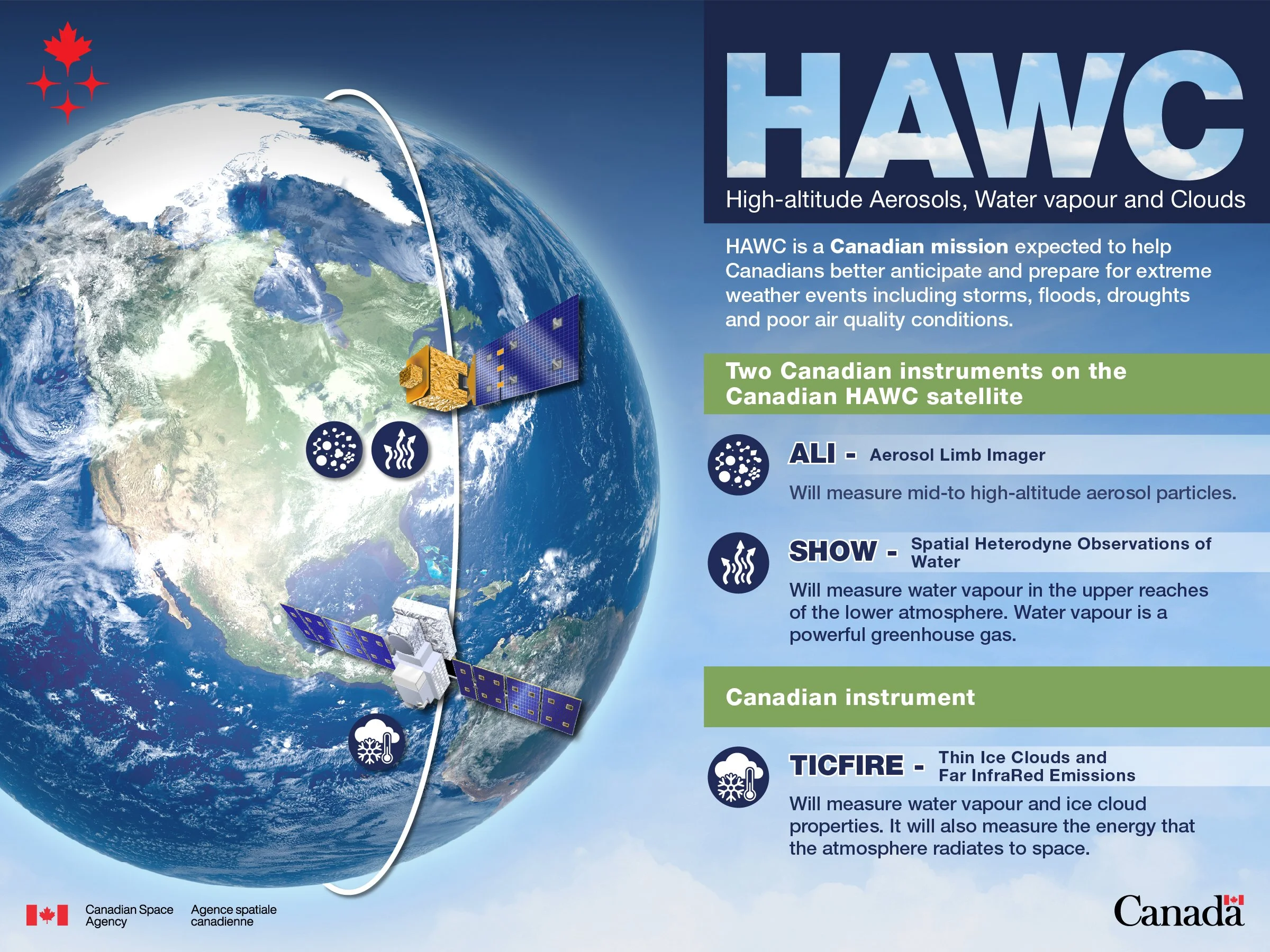
Description of the HAWC satellite mission and payload. Photo courtesy of the CSA.
PONEX is also a critical stepping stone for the upcoming HAWC (High-altitude Aerosols, Water vapour, and Clouds) satellite mission, set to launch no earlier than 2031. The data collected will help calibrate and validate satellite instruments, ensuring they deliver accurate readings once in orbit. The campaign will also support ESA’s EarthCARE mission, launched in May 2024.
What will happen on the ground and in the air?
Two surface sites near Inuvik will be buzzing with activity for several months, equipped with high-tech instruments like wind and water vapour lidars, radiometers, and precipitation sensors.
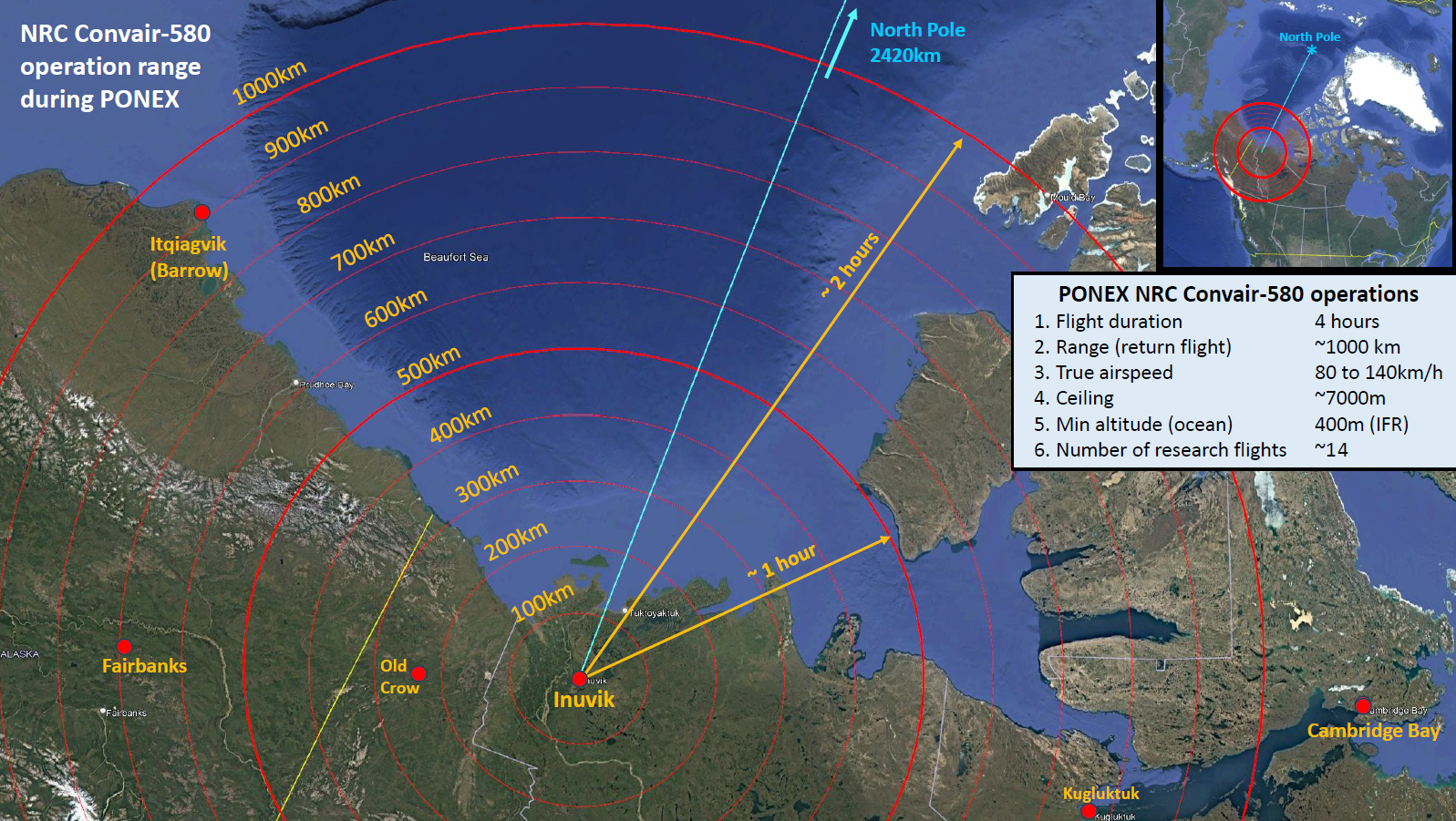
The PONEX area of operations in and around the Canadian Arctic. Figure credit: PONEX
These ground-based tools will work in tandem with aircraft flying overhead, collecting data to:
Calibrate and validate satellite sensors
Study the impact of thin ice clouds on radiation and climate
Investigate aerosol chemistry in the absence of sunlight
Improve the physics behind weather and climate models
One of the campaign’s most exciting components is the use of a high-resolution (1-km) numerical weather prediction model tailored for the Canadian Arctic. By comparing model outputs with real-world PONEX data, scientists hope to refine how we simulate Arctic weather and better understand how polar processes influence weather patterns across the globe.
A global effort for a global impact
Funded by the CSA, with contributions from ESA, PONEX is a shining example of international collaboration in the name of science. It’s not just about understanding the Arctic, it’s about understanding our planet. So while most of us will be bundled up indoors this January, a dedicated team of researchers will be braving the Arctic night, chasing data that could help us all better predict and prepare for the future.
For more information, please visit: https://ponex.hiwr.ca/.