

Kick-off of the PCAPS DON4FS Task Team
The PCAPS Task Team DON4FS – Distributed Observational Networks to Advance Coupled Forecasting Systems held its kick-off meeting on 8 January 2026. The meeting brought together participants from across the polar prediction community to establish a shared understanding of PCAPS, introduce the task team, and begin shaping its scientific and coordination priorities.
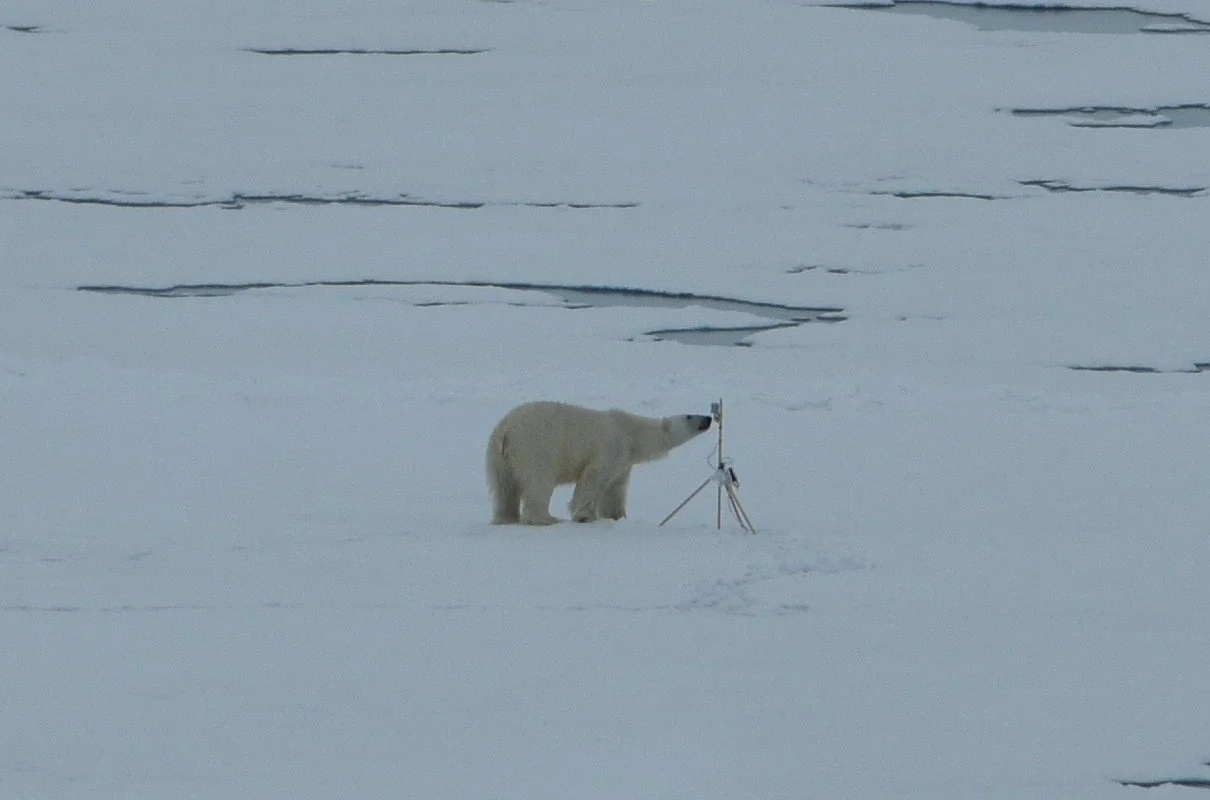
Stakeholder engagement during the ArctSum-25 campaign: No damage, just curiosity. Photo credit: Malte Müller
Co-led by Malte Müller and Jørn Kristiansen from the Norwegian Meteorological Institute, DON4FS aims to enhance the planning, deployment, coordination, and use of distributed observational networks to advance understanding and predictive skill in coupled atmosphere–ice–ocean–wave forecasting systems in the polar regions.
In addition to the co-leads, the DON4FS Task Team members are:
Jean Philippe Paquin (ECCC)
Marius Jonassen (UNIS)
Clare Earys (KORE)
Kevin Boyd (Univ. Illinois)
Sarah Keeley (ECMWF)
Mathew Shupe (NOAA)
Eric Bazile (Meteo France)
Lotfi Aouf (Meteo France)
Following brief group introductions, Jørn Kristiansen gave a short introduction to PCAPS. Building on the legacy of PPP and YOPP, PCAPS places a stronger emphasis on strengthening links across the research–operations–services value cycle, with the overarching aim of improving the actionability, impact, and fidelity of polar forecasts.
The presentation highlighted the role of PCAPS Task Teams as focused, time-limited coordination hubs where integration and synthesis take place. Rather than creating new projects or unfunded workloads, Task Teams are designed to coordinate, prioritise, and connect existing research activities. They help articulate shared scientific and service priorities, link relevant projects, centres, and datasets, identify gaps and opportunities, and support pathways from research to operations and services. Participation is based on active engagement and knowledge sharing, with contributions scaled to what is realistic alongside existing commitments. In return, Task Teams offer visibility within PCAPS and WWRP, access to a broader interdisciplinary research network, opportunities for scientific synthesis and collaboration, and influence on future research directions. Within this framework, DON4FS is positioned as a key task team addressing the observational foundations of coupled polar prediction.
Malte Müller provided an introduction to the role of distributed observational networks in improving coupled polar prediction, highlighting that the coupled atmosphere-ice-ocean-wave system remains difficult to forecast due to fast-evolving interactions and a scarcity of observations that resolve relevant spatial and temporal scales. Building on examples such as the MOSAiC distributed network, the presentation illustrated how coordinated in situ observations enable quantitative evaluation of coupled processes and provide critical benchmarks for forecasting systems, reanalyses, and satellite products. The talk also highlighted recent and ongoing efforts, including the Svalbard Marginal Ice Zone (SvalMIZ) campaigns, which established distributed networks of observations of the atmosphere, sea ice, and waves using low-cost open-source instrumentation (OpenMetBuoy), and the ArctSum-25 campaign in the central Arctic with enhanced sensor capabilities and ambitions for real-time availability and future operational use.
The meeting concluded with an initial discussion of DON4FS priorities and expected outcomes. Participants agreed that observational networks must increasingly support coupled forecasting systems by resolving the scales represented in current models, strengthening the availability of atmosphere–ice–ocean observations, and integrating satellite remote sensing alongside in situ networks. DON4FS plans to support coordination and synthesis across ongoing and planned campaigns, promote targeted datasets for model development and validation, and facilitate model intercomparison studies. Next steps include establishing regular meetings, inviting presentations on related initiatives, and exploring opportunities for joint workshops, including efforts linked to planned 2026 Arctic expeditions.